
 Veena
Choosing between braiding hair colors can feel harder than choosing the style itself. The shade you pick decides whether braids look natural, polished or playful, and it stays with you for weeks. This guide walks through the main colour families, how to match a shade to your skin tone and natural hair, and a few simple ways to test a colour before committing to a full install.
Table of Contents
Classic natural shades
Natural shades are the safest choice and never go out of style. Off-black and black blend with most natural hair and give a clean, sharp look. Dark brown is slightly softer and suits people who want a less stark finish. Medium and light brown add warmth and catch the light in a way that shows off the pattern of the braids.
Braiding hair is commonly sold with number codes, such as 1B for off-black, 2 for dark brown and 4 for medium brown. The numbers can vary a little between brands, so I’d compare the swatch on the packet against your own hair in daylight rather than trusting the number alone.
If you are unsure, black or dark brown is the lowest-risk pick. I’d save lighter shades for a second install, once you know how the colour behaves against your skin and wardrobe.

Warm and bold shades
Warm tones are popular for a reason. Honey blonde, caramel, auburn and copper brighten the face and suit warm undertones especially well. Burgundy and deep wine shades add richness without looking too dramatic, which makes them a good step up from plain black. Bright blonde makes a strong statement and usually looks best when the rest of the outfit stays simple.
If you want to see how bold colour fits a bigger style change, the broader advice in ways to achieve the perfect look is a useful companion.

Ombre, mixed and fantasy colours
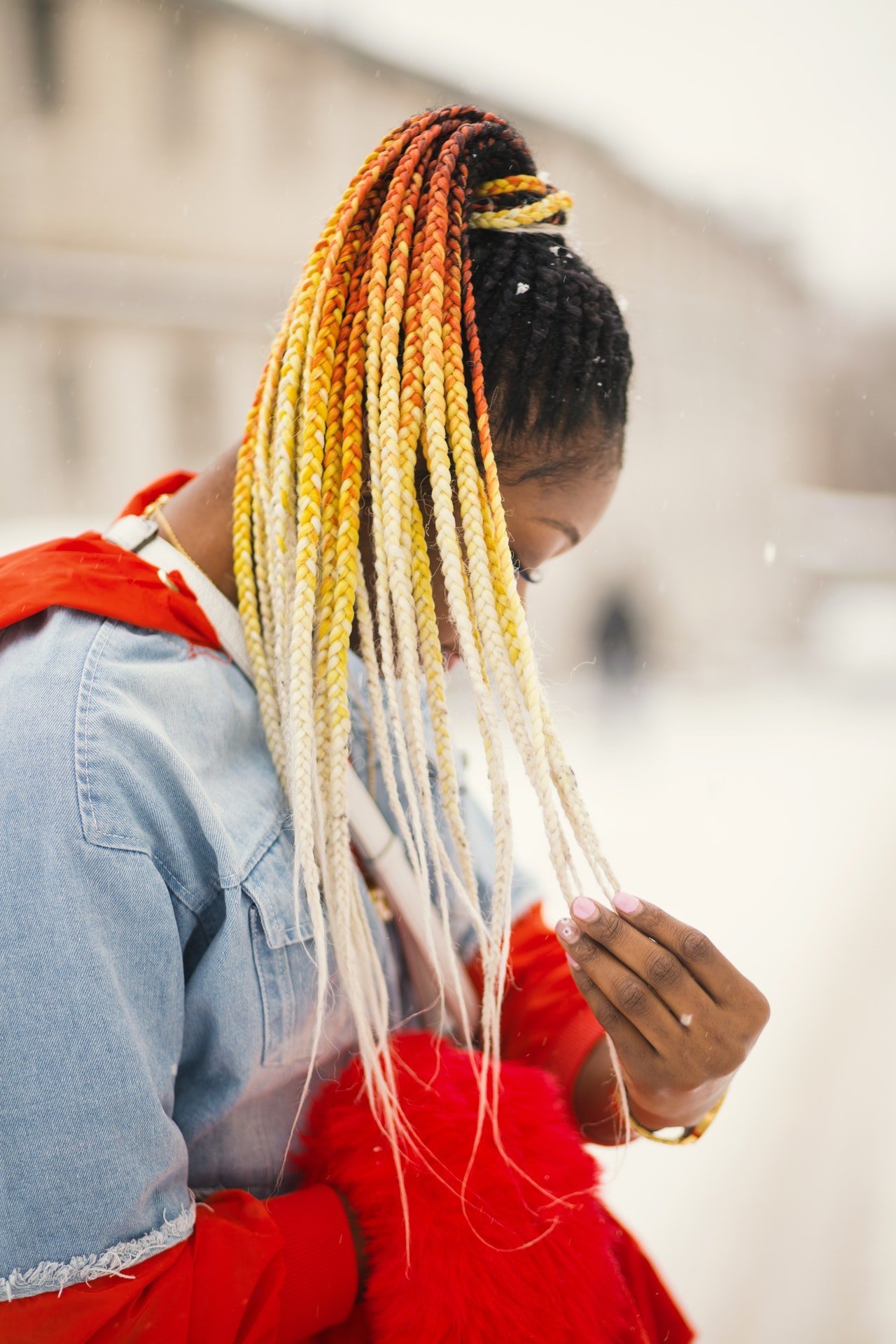
Ombre braids fade from a dark root into a lighter end, which gives depth and hides regrowth lines. Mixing two shades inside the same braid, for instance black with burgundy or brown with honey, adds subtle dimension. Fantasy colours such as blue, pink, purple and green stand out immediately and suit festivals, parties and creative looks.
For costume nights, braids in vivid shades pair neatly with the ideas in the Halloween makeup ideas post.
Ombre needs more planning than a single colour, since the point where the shades meet is visible in every braid. I’d ask the stylist to place the transition around the mid-length so it looks gradual, not abrupt. Bright fantasy colours also stain light clothing and pillowcases when new, so a dark scarf at night is a sensible habit.

How to match a colour to your skin tone
Start with undertone. A common, if imperfect, check is to look at the veins on the inner wrist: green-looking veins point to a warm undertone, blue-looking veins point to a cool one, and a mix suggests neutral.
- Warm undertones: honey, caramel, copper, auburn and golden brown.
- Cool undertones: jet black, plum, deep burgundy and cool brown.
- Neutral undertones: nearly everything, so choose by mood and outfit.
Contrast also matters. A shade close to the natural hair looks subtle, while a shade two or three tones lighter looks bold. I’d pick one step lighter than the natural hair for a softer change that still feels fresh.
Test a colour before you commit
Buy a single pack first and hold a few strands next to the face in natural light. Photograph it near a window, because phone flash changes the colour. If the shade looks very different on camera and in person, give it another look, since braids spend most of their time in ordinary light.
Looking after the braids matters as much as the colour. Overly tight styles can pull on the scalp and cause damage, and the American Academy of Dermatology’s guide to styling without damage has useful reminders about tension and heat. If you plan to curl the ends of synthetic braids, read up on how to curl your hair safely, since synthetic fibre reacts to heat differently from natural hair.
I’d also take a friend’s opinion. A second pair of eyes spots a shade that looks too harsh or too flat long before a mirror does.
Care tips that keep colour looking fresh
Wash the scalp gently and let the braids dry fully, because damp hair under extensions can cause odour and irritation. Use a light mousse or oil to tame frizz, and wrap the hair at night in a satin scarf. Avoid heavy products that leave a film on bright colours. If you want extra volume under the braids, see the note on hair toppers for a different way to add fullness.
Frequently asked questions
How many packs of braiding hair do I need?
It depends on length, thickness and style. Many stylists buy several packs, so ask yours for an estimate before shopping.
Which colour lasts best?
Natural shades fade the least. Bright colours can look dull faster, especially in strong sun.
Can I dye braiding hair myself?
Synthetic fibre does not take regular dye well. It is easier and safer to buy the shade you want.